.bt{max-width:42rem;margin:0 auto;padding:0 .75rem 2.5rem;line-height:1.55;font-size:1.05rem}
.bt h2{font-size:1.25rem;margin:1.6rem 0 .7rem}.bt figure{margin:1.2rem 0}
.bt img{width:100%;height:auto;border-radius:10px;background:#120f18;display:block}
.bt figcaption{font-size:.85rem;color:#555;margin-top:.35rem}
.bt .cite{font-size:.9rem;border-top:1px solid #ddd;margin-top:1.5rem;padding-top:.8rem}
.bt .soft{background:#f7f4fb;border-left:4px solid #7e57c2;padding:.7rem .9rem;margin:1rem 0}
.bt ul{padding-left:1.2rem}.bt li{margin:.35rem 0}
@media(min-width:720px){.bt{font-size:1.1rem}}
BrokenTokn is a quiet landing place for a loud problem: language models fail in ordinary, tedious ways when context runs out, instructions drown, or token budgets surprise the people paying the bill. This page stays in public industry language. No proprietary systems. No “secret sauce.” Just the failure modes operators already recognize.
Why a soft lander
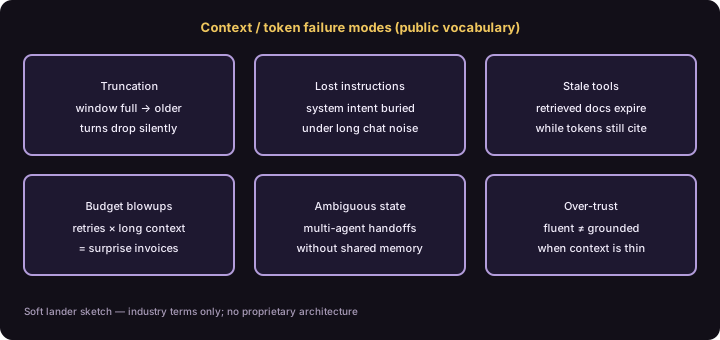
Most marketing copy pretends tokens are infinite and retrieval is always fresh. Production teams know better. Truncation drops early constraints. Long chats bury the system intent. Tool results go stale while the model still cites them fluently. Retries multiply cost. None of that requires a novel theory — it requires respect for meters and memory.
What you will not find
- Architecture diagrams of private stacks.
- Hype benchmarks with cherry-picked prompts.
- Instructions for bypassing safety systems.
What you will find: dense, visual notes on failure modes that show up in public papers, vendor docs, and incident write-ups. Start with the essays linked from this face.
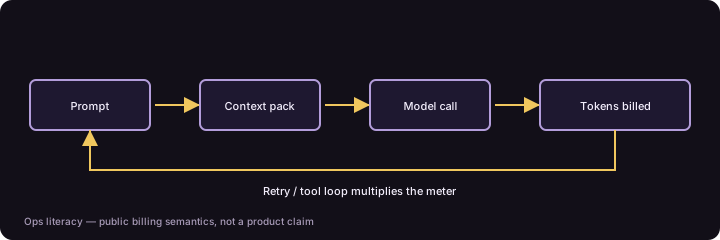
Orientation sources (public): vendor context-window documentation; academic and industry postmortems on retrieval staleness and instruction hierarchy; standard API billing semantics for input/output tokens. Soft lander — educational framing only.